
How Much Does Solar Panel Installation Cost in Chennai in 2026?
Buying guide · 23 October 2026 · 7 min read
There is no single price for solar panel installation in Chennai in 2026. A full plant, with modules and an inverter chosen for the bill, is a different job from fitting equipment you already bought. Mixing those two figures is how a cheap message becomes an expensive roof.
ZeroEB prints one rate before anyone stands on the terrace. Labour for equipment you already own starts at ₹3,000 per kW. A complete plant is not a rate per panel, and it is not printed on this page. The visit is free. The figure comes after it.
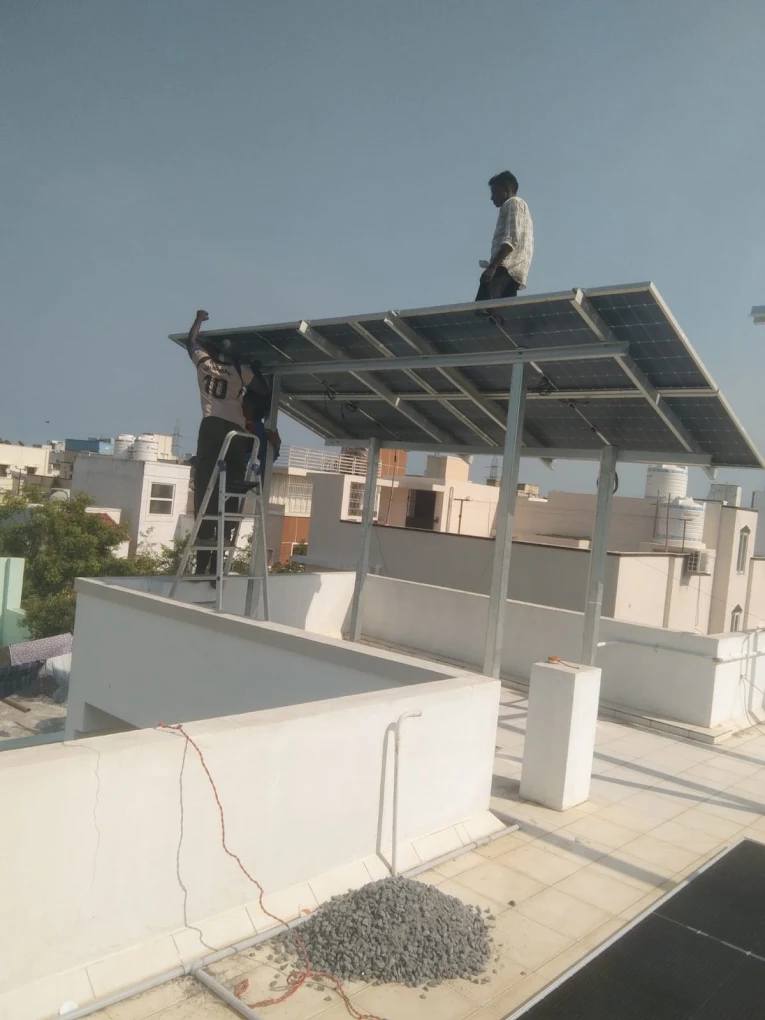
The rate we will put in writing before a visit
Residential labour-only installation starts at ₹3,000 per kW. That covers civil work for the mounting structure, fitting the modules and the inverter, AC and DC wiring, earthing, testing, commissioning, and clearing the site. It applies when the panels, the inverter, the structure steel, and the cables are already yours, unless we agree otherwise.
It does not include the modules, the inverter, structure materials, cables, MC4 connectors, MCBs, SPDs, isolators, net-meter fees, or subsidy processing. The split is listed on the installation services page. If a message quotes ₹3,000 per kW for a “full solar system,” it is describing a different job from the one we do at that rate.
What a full plant price is made of
A complete residential quote has to name the modules, the inverter, the structure, the cable, the earthing, the testing, and who stays for commissioning. How to compare solar quotes is the checklist. Hide the structure or the cable run and the lower number is not comparable.
Through 2026, Chennai companies have commonly been quoting about ₹55,000 to ₹85,000 per kW for a residential plant before subsidy. That is the range homeowners are being shown. It is not a ZeroEB tariff. An elevated frame, a long drop to the inverter, a parapet that shades a row, or a walkway the family still needs will move a real quote inside or outside that band. We do not adopt the band as our price.
Modules are usually the largest share of that hardware. The inverter is the next. Structure, cable, and the civil work on a used terrace are where two quotes for the “same” kilowatts stop being the same. Shade and the open strip decide how many of those kilowatts fit. A small terrace often holds less than the first sketch.
Subsidy in 2026, written as its own line
Under the central PM Surya Ghar scheme, eligible residential grid-tied plants using DCR modules can receive ₹30,000 per kW for the first 2 kW and ₹18,000 for the third kilowatt. The central cap is ₹78,000. Capacity above 3 kW does not raise that central figure. Amount and approval follow the current scheme. DCR is required for that assistance. NDCR can look cheaper only if you give the subsidy up. That comparison is in NDCR vs DCR solar panels.
Tamil Nadu added a state top-up for domestic consumers who applied from 5 August 2026. The state government has described the combined central and state assistance as ₹35,000 for 1 kW, ₹70,000 for 2 kW, and ₹1,00,000 for 3 kW. The state share on the TNPDCL rooftop portal is shown as ₹5,000, ₹10,000, and ₹22,000 for those three sizes. Check the portal before you treat a WhatsApp price as already reduced. The subsidy is credited after installation, inspection, and approval. It is not cash already sitting in the quote.
Ask for the subsidy as its own line, next to the equipment total, not folded into a single “after subsidy” number. If the price only looks attractive because it assumes both subsidies are approved, ask to see the same quote with the subsidy removed.
What moves the figure on a Chennai terrace
The bill decides what is worth generating. The roof decides what can be built. One kilowatt of well-installed, unshaded rooftop solar here produces roughly four to four and a half units a day across the year. That is a planning figure for generation, not a price, and not a promise that two air conditioners mean 2 kW. Capacity is worked out in how system size is actually decided.
A tank, a stair cover, and a path the family still uses come off the drawing before anyone counts modules. A row forced against the parapet is not a saving. Heat on a May afternoon also means a datasheet watt is not the unit you will see at 2 pm. Those are reasons a citywide rate per panel misleads.
Generation can start on commissioning day. The TANGEDCO statement changes after the net meter is replaced. A price that assumes the next bill is already lower is skipping that step. The sequence is in when the EB bill actually changes.
Cleaning is not inside the installation price
Panel cleaning is a later visit, priced by system size: ₹750 per kW up to 3 kW, ₹600 up to 5 kW, ₹500 up to 10 kW, and ₹450 above that. An annual maintenance contract saves 25% on each clean. Dust in Chennai is part of owning the plant. It is not a discount to argue into the installation quote.
How to read the number you are sent
Line up two quotes only after each one names the module type, the inverter, the structure height, the cable, earthing, testing, commissioning, and the subsidy as its own line. A lower total that drops the structure, or that treats ₹78,000 or the state top-up as money already received, is not the cheaper plant.
Questions homeowners ask
How much does solar panel installation cost in Chennai in 2026?
If you already own the panels and the inverter, ZeroEB’s residential labour starts at ₹3,000 per kW. A full plant is quoted after a free visit. Citywide quotes this year have often sat around ₹55,000 to ₹85,000 per kW before subsidy. That range is not our price list.
Is the subsidy already taken off the price?
Only if the quote shows it as a separate line and says it is subject to approval. Central assistance is capped at ₹78,000 for an eligible DCR residential plant. The Tamil Nadu top-up, for applications from 5 August 2026, is additional and is not automatic.
Does a bigger plant always get more subsidy?
No. The central amount stops rising after 3 kW. A 5 kW plant can be the right size for the bill and still carry the same ₹78,000 central cap as a 3 kW plant. The state top-up described for 3 kW does not keep climbing with every extra kilowatt.
Why will you not print a plant price on this page?
Because the terrace, the daytime units, and the equipment list change the number. Bring a recent EB bill to the Madipakkam office. Nothing is ordered until you ask.