
Solar installation in Chennai: what to expect before you sign.
Heat, monsoon, TANGEDCO net metering, subsidy, and how to tell a real rooftop quote from a headline kilowatt price.
Read the article →Two quotes for the same rooftop often look identical until the panel line. One says DCR. The other says NDCR and a lower price. For a Chennai home that wants the central subsidy, that one word decides whether the cheaper quote is actually cheaper.
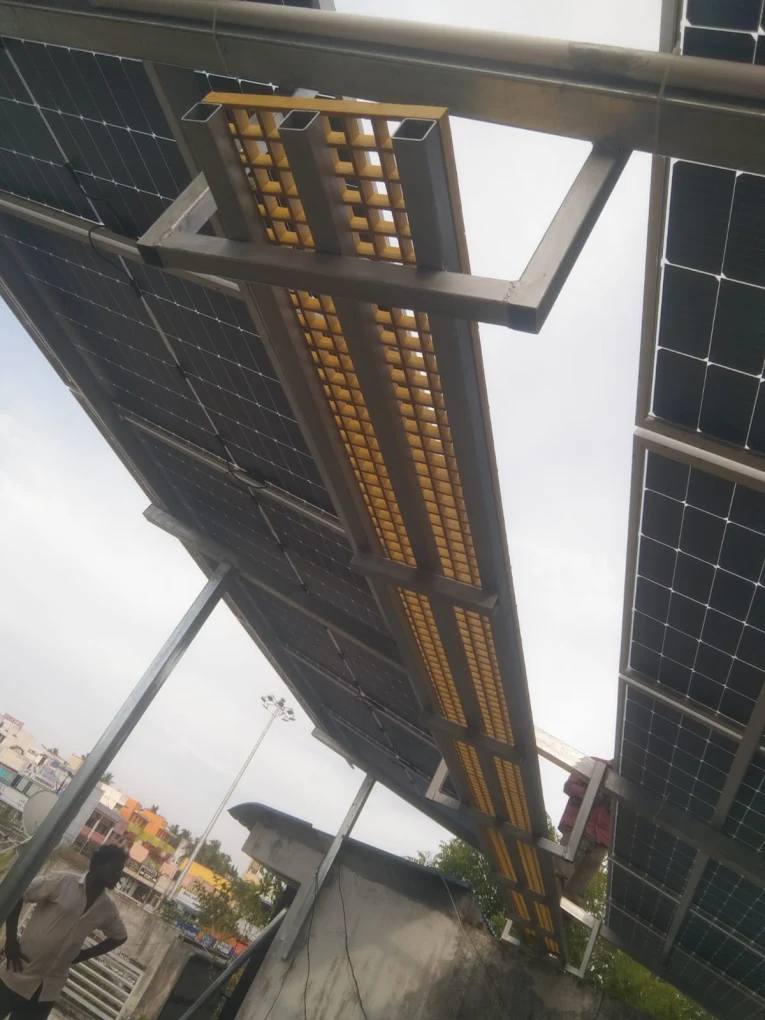
DCR stands for domestic content requirement. Under schemes such as PM Surya Ghar: Muft Bijli Yojana, DCR means the solar cells and the modules are manufactured in India.
NDCR means the panels do not meet that requirement. These modules often use imported cells. They can still be a working, warranted product. They are simply outside the rule that the subsidy scheme sets for cells and modules.
DCR is not a quality stamp, and a darker panel is not a DCR panel. Colour, brand, and wattage are separate questions — we cover the colour myth in are darker solar panels better?
If you want central financial assistance for a residential rooftop plant, the modules have to be DCR. Eligible homeowners can receive a government subsidy of up to ₹78,000. Amount and approval follow current scheme rules.
Ask the supplier for the DCR certificate for the exact model on the quote, not a generic letter about “Indian panels.” A module assembled in India from imported cells is not the same thing as a DCR module.
DCR and ALMM are different checks. ALMM is the ministry’s approved list of models and manufacturers. Net-metered plants are expected to use listed modules. A subsidy plant also needs domestically manufactured cells and modules. Ask for the datasheet, the DCR certificate, and the ALMM listing as three separate documents.
The national portal has a Give It Up option for homeowners who choose not to take the central subsidy. Those applications can be submitted without a DCR certificate. Once that non-DCR submission is confirmed, the choice cannot be changed later. A DCR installation can still change the Give It Up choice until the subsidy is redeemed.
That is the practical rule: NDCR is an option only if you are willing to give the subsidy up, and you should decide that before the panels are ordered. You cannot install NDCR modules and apply for the same subsidy afterwards.
For most homes in Chennai and Madipakkam that qualify, DCR is the default. The subsidy is often larger than the module-price gap, and it keeps the application valid. NDCR only wins when you have already decided to skip central assistance and the cheaper modules still look better after that loss.
Make two quotes comparable before you argue about brand. Our guide on what matters when buying solar covers structure, inverter, and wiring. For this decision, add four panel questions:
ZeroEB’s solar installation in Chennai quotes spell out the plant, the paperwork, and subsidy support for eligible homes. If you only need labour on panels you already bought, that is a different job — and those panels still have to match the subsidy path you want.
DCR solar panels use solar cells and modules manufactured in India. That is the domestic content requirement for the central rooftop subsidy. NDCR panels do not meet that requirement and usually use imported cells. DCR is a manufacturing rule, not a quality grade.
Yes. Homes claiming central financial assistance under PM Surya Ghar need DCR cells and modules. Eligible homeowners can receive a government subsidy of up to ₹78,000. Subsidy amount and approval follow current scheme rules.
Not automatically. Compare wattage, efficiency, temperature coefficient, and warranty. NDCR modules are often cheaper per watt, but that saving is usually smaller than the subsidy a qualifying home gives up.
No. If an application is submitted without a DCR certificate under Give It Up, that choice cannot be changed after confirmation. Order DCR modules if you want to keep the subsidy path open.
Keep reading
Heat, monsoon, TANGEDCO net metering, subsidy, and how to tell a real rooftop quote from a headline kilowatt price.
Read the article →
Colour tells you almost nothing about output or lifespan. Here's what to compare instead—efficiency, heat performance, warranty, and roof fit.
Read the article →
Two quotes for the same capacity can describe different projects. How to make them comparable, and the red flags to watch for.
Read the article →Next step
We’ll size the plant from your roof and your bills, and say whether the modules are DCR before you commit.