
Going solar doesn't mean giving up your EB connection.
How a grid-tied system shares the load with the grid, where the net meter fits in, and why going fully off-grid rarely adds up at home.
Read the article →For a Chennai house that already has an electricity connection, on-grid is usually the better system. The roof covers a share of the daytime load, the grid covers the night, and you do not buy a battery bank just to keep the lights on after sunset. Off-grid and hybrid are real options. They answer a different question: what should the house do when the EB supply is not there?
“Better” is not the system with the most equipment. It is the one that matches how the house uses power, how often the supply fails, and whether anyone has written the battery, the structure, and the papers as separate lines.
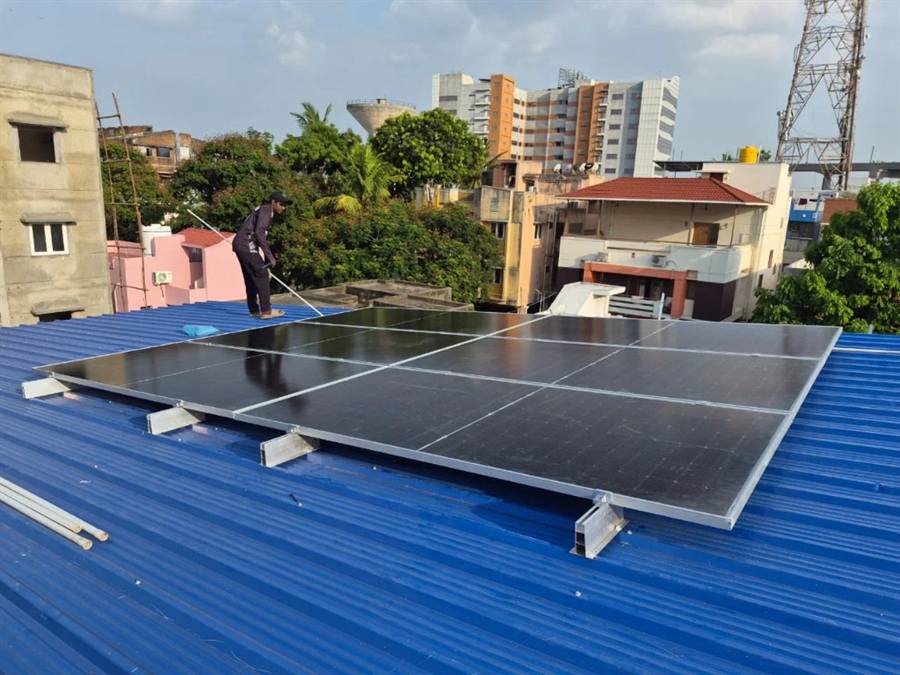
An on-grid system, also called grid-tied, stays connected to TANGEDCO. Through the day the panels supply the house first. If the house is using less than the array is making, the surplus can go out through a net meter. If a cloud or a heavy load outruns the panels, the grid makes up the difference. At night the house runs on the EB line, as it does now.
You keep the connection. That is the arrangement in going solar does not mean giving up your EB connection. There is no battery to replace every few years, and the plant is sized from the units you already use. How capacity is decided starts from the bill, not from an appliance count.
An on-grid inverter does not run the house during a power cut. When the EB supply fails, the inverter switches off so it does not send power into a dead line. The lights go off with the street. If backup is the reason you are buying solar, on-grid alone will disappoint you.
An off-grid system is not connected for export, and it is not designed to lean on the EB line after sunset. Daytime generation charges a battery bank. The house draws from those batteries when the sun is down, and on a dull monsoon day the batteries are the reserve.
That is a different plant. The battery has to be large enough for the night load you actually want, not for every appliance at once. A fridge, a few lights, and a fan are a different battery from an air conditioner running until midnight. Cloudy weeks still happen in Chennai, so the bank cannot be sized to a single clear day in February.
Off-grid makes sense where there is no usable EB connection, or where the brief really is to run without the grid. For a house that already has a service connection, it is rarely the better default. You give up export, you take on batteries that age, and you still have to be honest about what stays on after dark.
A hybrid system keeps the EB connection and adds storage. When the grid is up, it behaves like an on-grid plant: the roof serves the daytime load, and a net meter can account for surplus. When the supply fails, the battery keeps selected circuits on. Those are the circuits you chose, not automatically the whole house.
Which circuits, and for how long, depend on the battery and on what you leave switched on. We do not promise a number of hours on this page. A visit has to see the loads you want during a cut, and how often those cuts actually happen on your street.
Hybrid is the better fit when outages are part of the brief and you still want the grid for the rest of the month. It is more equipment than on-grid. It is not better only because the word sounds complete.
Shade still decides output, whichever name is on the quote. A tank, a stair cover, or a neighbour’s wall can cut a row after mid-afternoon. As a planning figure, one kilowatt of well-installed, unshaded rooftop solar in Chennai produces roughly four to four and a half units a day, averaged across the year. That figure is for generation. It is not a battery runtime.
Eligible homeowners can receive a government subsidy of up to ₹78,000 when the modules are DCR and the file is approved. Amount and approval follow current scheme rules. The path we help with is a grid-connected residential plant. An off-grid quote should not treat that subsidy as money already in the price. DCR and NDCR are a separate choice, covered in NDCR vs DCR solar panels.
A full plant, whether on-grid, hybrid, or off-grid, is written after a free visit. It is not a rate per panel, and it is not printed here. If you already own the modules and the inverter, labour for fitting that equipment starts at ₹3,000 per kW. The equipment, the structure steel, the cables, the batteries, and the papers sit outside that labour figure. The inverter you already bought still has to match the system type. A grid-tied inverter is not an off-grid inverter.
Ask every quote the same questions before the brand argument starts. How to compare solar quotes covers structure and wiring. For this choice, add three more: is there a battery, which circuits does it hold during a cut, and is the subsidy shown as its own line or assumed inside the total?
Whether the plant is worth it still depends on the bill and the shade. The system type does not skip that test.
For most Chennai houses that already have an EB connection, on-grid is the better fit. It uses the roof for daytime units and keeps the grid for the night. Off-grid is for a site that must run without the grid. Hybrid adds a battery when backup during a power cut is part of the brief. The plant figure is written after a free visit.
No. A grid-tied inverter switches off when the EB supply fails, so it does not back-feed a dead line. Lights go off with the rest of the street unless a separate battery or hybrid system is keeping selected circuits on.
Not as a rule. Off-grid adds batteries sized for night and cloudy days, and those batteries are replaced in time. There is also no export to the grid. We do not print an off-grid price on this page.
The subsidy path we help with is for an eligible grid-connected residential plant using DCR modules, up to ₹78,000. Amount and approval follow current scheme rules. An off-grid plant is a different file, and it should not be quoted as if that subsidy is already included.
Keep reading
How a grid-tied system shares the load with the grid, where the net meter fits in, and why going fully off-grid rarely adds up at home.
Read the article →
A clear roof and a daytime bill can make rooftop solar worth it. A shaded terrace or a night-only load often does not.
Read the article →
Capacity comes from the units you consume, not an appliance count. A worked example using Chennai generation figures.
Read the article →Next step
Bring a recent bill. We’ll say whether on-grid is enough, or whether a battery belongs in the brief, before a figure is written.